Before the Flat Panel: When Television Became a Household Screen
Before flat-panel televisions, the CRT cabinet anchored the living room. Trace how slimmer screens changed television’s place in the home and its role as furniture.
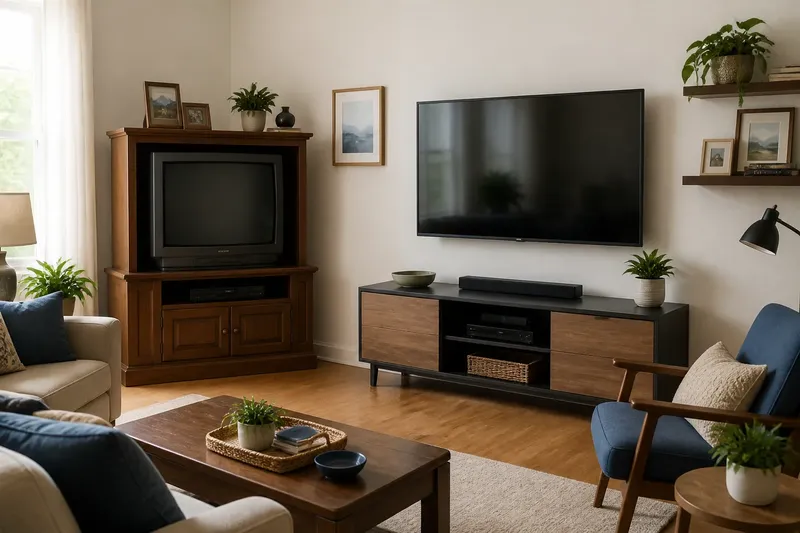
A deep television cabinet once claimed a corner of the living room, its screen facing the sofa and its bulk shaping the path around it. The change to flat-panel televisions altered more than the display: it changed how a screen could fit into a home.
The CRT Cabinet
A cathode-ray tube, or CRT, formed its picture inside a large glass tube that extended behind the visible screen. The set needed depth and a sturdy support, so manufacturers often enclosed the display in a cabinet with a finished, furniture-like appearance.
That shape limited placement. A television might sit on a broad stand, but it could not rest close to the wall like a thin panel. Its weight and outline made the set a substantial household object, whether or not anyone was watching.
The Living Room Center
When the television occupied a fixed spot, the sofa and chairs often faced it. This arrangement was not universal, but the CRT’s size made a central, seated viewing position practical. The set’s cabinet could also blend with other furnishings through wood tones, shelves, or rounded edges.
Television was therefore both a picture and a piece of furniture. When switched off, its dark screen remained visible, while the cabinet continued to take up floor space and influence how people moved through the room.
Flat-Panel Television History
Flat-panel displays changed the geometry of the television. Without a long tube extending behind the screen, a set could rest on a narrower stand or be attached to a wall. It still needed suitable support and a place that worked for viewers, but it no longer required a deep cabinet because of its own shape.
This shift expanded the available arrangements rather than dictating one. A household could keep a television on furniture, mount it above a console, or place it where a bulky CRT would have been difficult to accommodate. The screen became easier to treat as one element in a room instead of the object that determined its layout.
Imagine a family replacing a CRT that sits on a broad corner stand with a flat panel. They move the new screen to the wall above a low console and place a reading chair in the vacated corner. The visible result is a more open corner and a television that still faces the seating, while the display takes up less floor space.
The Wall as a Viewing Place
Mounting a television brought the wall into the viewing arrangement. A screen could sit near framed art or shelves rather than being confined to a deep stand. The change also made its surroundings more visible: cables, connected devices, and the furniture beneath the screen remained part of the room.
Thinness did not settle every placement question. A high position might look orderly from across the room but feel less natural from the sofa. A stand or console could keep equipment together and make the screen easier to move. The useful historical distinction is that the flat panel offered options the CRT’s depth had restricted.
Screen Placement Questions?
Did flat panels end the television cabinet?
No. Some flat panels still sit on consoles, which can support the display and hold related equipment. What changed was that a deep cabinet was no longer required by the screen’s shape.
Did thinner screens make television less central?
They made it possible to give the display less floor space, but its physical profile did not determine how much attention it received. A wall-mounted television could remain the room’s focal point, while a cabinet-style set could blend into its surroundings.
Why did CRT televisions need deep furniture?
The CRT picture formed inside a glass tube that extended behind the screen. The cabinet enclosed that depth and provided a support, making the set harder to place close to a wall than a flat panel.
What did flat panels change in the home?
They gave households more choice about where a screen could go and how furniture could be arranged around it. The display could occupy a wall or a narrower stand without the same built-in depth.
Furniture After CRTs
As televisions changed, some cabinets lost their original purpose. A piece of furniture might remain useful for storage, or it might take up space without serving the room. That small domestic shift reflects the larger transition: the display no longer dictated the furniture’s shape.
It is not worth treating every old cabinet as a design problem that needs a clever new use. The important historical point is simpler: CRTs arrived as substantial furniture-like objects, while flat panels separated the screen from the deep cabinet that had once housed it.
A Different Household Screen
The move from CRT to flat panel changed the television’s physical relationship with the home. The older set brought its own depth and footprint; the newer screen could sit on a narrower support or share a wall with other objects. That gave households more freedom to arrange their viewing space.
Flat-panel television history is not just a story of thinner displays. It is also a story of how the screen shifted from a cabinet that helped organize the living room to a more flexible object within it. The shape changed the choices available, while the household still decided what place television would take.